
Sharing Climate Action in College: East Midlands FE Sustainability Network
Colleges from across the East Midlands met at Nottingham College for a morning of sharing and learning around sustainability and climate action. Colleagues were given a chance to share their own experiences and ideas for their respective colleges through active discussion in this workshop led by the Climate Ambassadors programme.
‘Doing’ sustainability and climate action looks different for every phase of education. Whether it’s a nursery, school or college, the size of a setting – both in terms of physical site and the staff and learner community – available funds, local context and existing priorities have a significant influence on how education settings approach sustainability and climate action. Often, these factors contribute to barriers preventing settings from acting.
For further education (FE) colleges, the challenge of overcoming barriers to action can be large and overwhelming. Yet, these challenges do not have to be overcome alone. Working in collaboration as part of a wider college community is key to impactful climate action. By sharing existing practice, stories of success and examples of climate action plans or sustainability strategies, colleges can take inspiration and work together to problem-solve and progress on their journey.
In December 2025, colleagues from several colleges across the East Midlands came together at Nottingham College, hosted by the East Midlands Regional Hub for the Climate Ambassadors Scheme, for a morning of sharing and learning around sustainability and climate action. During the session, we heard from Laura Mayhew-Manchón, Head of Sustainability at Nottingham Trent University, Jane Dickson, Climate Ambassadors Partnership Manager, and Matt Bunn, Sustainability Lead at Nottingham College, each providing a different perspective on sustainability and climate action in FE.
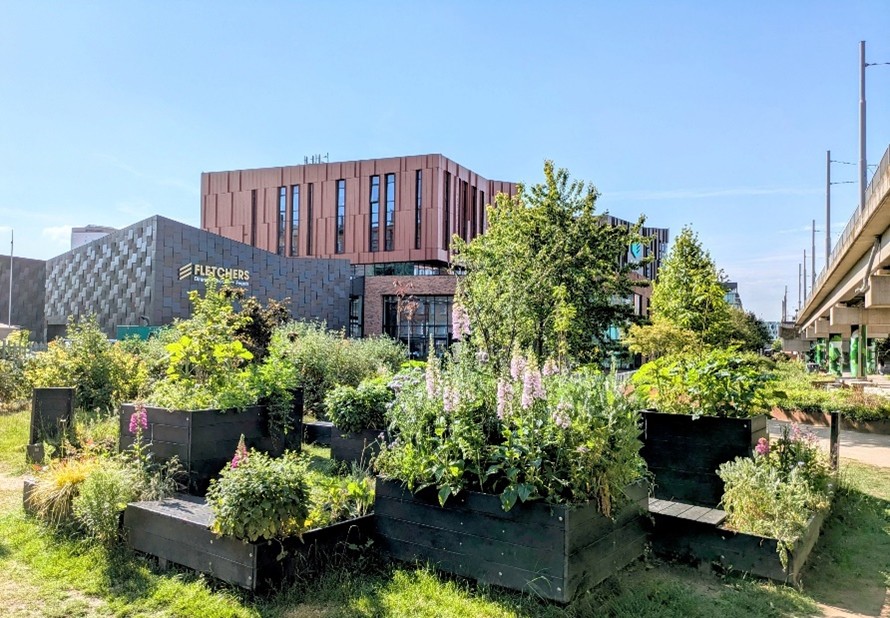
Matt Bunn shared their journey to achieve the Green Gown Award for Sustainability Institute of the Year 2025. Nottingham College works with local sustainability community groups, sharing their work and taking their climate action beyond the ‘four walls’ of college. The college has focused on:
- increasing biodiversity around their campuses through the Wilding Campuses project
- supporting students to creatively develop sustainability initiatives and projects as part of the Sustainable Future Programme, which will be running again in 2026.
- Developing and delivering a mature Sustainability Strategy that is a great example for other colleges to follow.
Many similarities can be seen between the way a college and university operate despite the size difference. Laura Mayhew-Manchón provided colleagues with an overview of sustainability at Nottingham Trent University and how to move from strategy to action, focusing strongly on the power of teamwork. Laura shared three key successes to sustainability in FE:
- 1) Sustainability should be the holistic golden thread that runs through every aspect and area of operations, teaching and learning, and student experience.
- 2) Sustainability needs to be student-centric, involving their ideas and voices as much as possible.
- 3) Collaboration with others supports impactful sustainability and climate action, building networks and communities who can work together to progress.
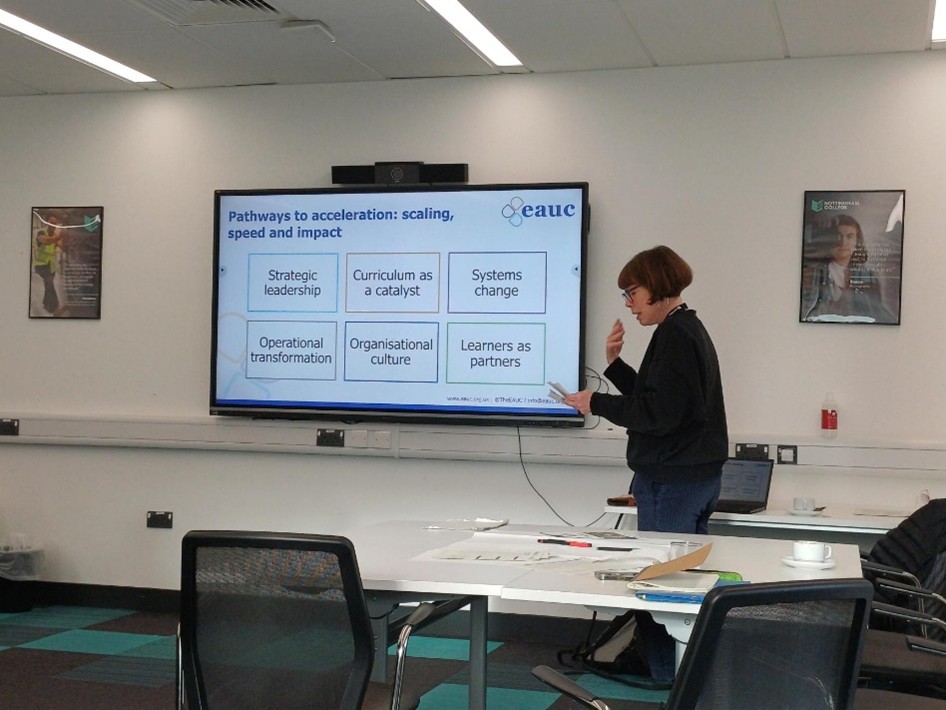
Finally, Jane Dickson spoke to colleagues about the needs and requests from the FE sector that are communicated to the Environmental Association of Universities and Colleges (EAUC). These include: policy consistency, technical support, accessible and appropriate funding, CPD, cross-institutional connections, and ambition across the education setting. The EAUC supports FE to work towards changing the systems that enable sustainability and climate action. It’s clear that this work is not easy but can be extremely impactful when done in collaboration with the right support systems in place.
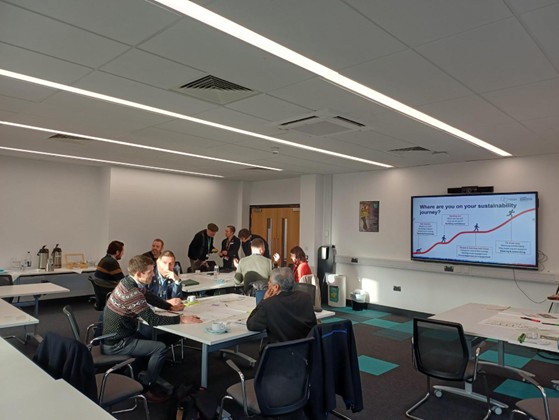
Colleagues were given a chance to share their own experiences and ideas for their respective colleges through active discussion towards the end of the session, drawing on what had been shared by the speakers. Many creative examples were shared, including how the library team at Northampton College are embracing sustainability through repurposing of books, an increase in the use of e-books rather than new physical copies, and pen recycling schemes. Bilborough College have set up a sustainability working group and have drafted their first climate action plan. This group includes a range of students working alongside staff members, encouraging inter-generational problem-solving and innovation. Several colleges are also exploring the installation of EV charging points or heat pumps.
It became clear during the morning that the space to share, network and learn from each other is vital as colleges progress on their sustainability journeys. One colleague from Lincoln College said of the session it was “really useful just to connect with others (in-person too) and gain an understanding of where institutes are at”.
A second session is already planned for March 2026 to continue what has already begun.
If you are part of a FE college and would be interested in joining the next East Midlands FE Sustainability Network to connect with others and progress your climate action plan or sustainability journey, please contact:
East Midlands Regional Hub ca-eastmidlands@nottingham.ac.uk to receive the details or sign up via the button below.
Written by Matilda Crane, East Midlands Regional Hub Manager for the Climate Ambassadors Scheme.
January 2026